

Category: White Paper

White Paper 1

Paragraph Heading 1

This is some placeholder body text for a test article. The text can be edited here (WordPress editor) or through Elementor if you’d like more design and customization options. To edit through Elementor, delete the text and click the “Edit with Elementor” button above.

Paragraph Heading 2

For articles, make sure to tag the category “Article” to the right, choose or add a topic, choose or add an author (labeled “Scholar”), and upload a featured image.

Paragraph Heading 3

Articles need a short summary for the listing cards. Add that below in the meta box called “Articles, Book Notes, White Papers, Weekly Roundup.” There is also an option field to insert a PDF download in that box if you’d like.

Paragraph Heading 4

For any content type, you have the ability to display a featured chart on the homepage. To do that, go to the “Featured Chart” meta box below, select “Yes” and add a chart name and image.
Understanding Their Path to Choose

Executive Summary

Purpose

Even after Roe v. Wade was overturned, abortion rates remained steady. While policy plays a role, this research study calls churches to recognize their responsibility to shape hearts and restore trust with compassion and clarity.

Research overview

4,000 Gen Z women (ages 13–26) surveyed nationwide.

500 in-depth interviews conducted for deeper insights.

Diverse sample: race, income, religious background, geography.

Timeline: February 21 – March 1, 2024.

Key Findings

Faith Perspective

Church attendance falls from 38% (teens) to 24% (ages 22-26).

Life Framework

Placeholder

Building Relationships

Placeholder

Pregnancy Attitudes

Placeholder

Choosing Life

Placeholder

Strategic Recommendations for the Church

1

Focus on pre-college discipleship and formation

Because of the sharp drop-off in church attendance post-teen years, churches must prioritize faith formation while Gen Z women are still in youth group. This includes clear, compassionate teaching on sexuality, identity, and the value of life.

2

Frame Life as Empowerment Rooted in God’s Design

Frame pro-life messaging not just in moral terms but as empowering. Emphasize strength, dignity, and the fulfillment of God’s purpose in motherhood, especially when the world says success requires avoiding parenthood.

3

Provide Practical Support

Offer material, emotional, and spiritual support: baby supplies, daycare help, housing, career coaching, and access to trusted professionals. Pastors can also equip their churches to partner with community services and pregnancy resource centers.

4

Rebuild Trust Through Authentic Ministry

Given that many Gen Z women distrust institutions, pastors must model integrity, empathy, and humility. Offer space for open conversations without shame, train lay mentors, and publicly affirm a woman’s value regardless of her past or decisions.

Conclusion

Gen Z is not abandoning spirituality — they are redefining it. To encourage life-affirming choices, we must meet their emotional, financial, and relational needs, speak to their dreams for self-empowerment, and rebuild trust with compassion and authenticity.

Introduction

Despite the repeal of Roe v. Wade and the implementation of stricter abortion laws in 14 states, abortion rates have increased. The availability of abortion pills and the funding of out-of-state procedures by organizations like Planned Parenthood have helped sustain abortion rates, even in restrictive states. The persistence of abortion rates suggests that legal measures alone are not sufficient to change behavior. The study emphasizes that convincing more women to carry pregnancies to term rather than choose abortion will require a change in hearts as much as laws.

Gen Z women are at a unique stage in life because they are on the cusp of many romantic and relational firsts. Gen Z, like the Millennials who preceded them, are making partner and romantic decisions much later than Baby Boomers and Generation X. Therefore, a study of these young women’s attitudes toward reproduction and relationships are as much about what they anticipate or aspire to, as they are reality. It is a window into their current state of mind, but also what they anticipate about their own future.

This is important because when a pregnancy is unexpected or unplanned, these attitudes will almost certainly be the driving force behind the actions that happen quickly.

Given that most abortions happen within six weeks of conception, primarily using chemical abortifacients (mifepristone and misoprostol) to end pregnancy, the views of these women before and at the time they discover they are pregnant are especially important as they make their decisions.

Methodology

The study utilized a mixed-methods approach, combining quantitative surveys and qualitative interviews to provide a comprehensive view of the factors influencing pregnancy decisions.

The study relied on a nationwide survey conducted among 4,000 Gen Z women aged 13 to 26. The sample was selected to ensure diversity across race, socioeconomic status, religious affiliation, and geographic location. The survey collected data on attitudes toward pregnancy, abortion, faith, financial stability, and social influences, providing statistical insights into the most common beliefs and decision-making factors.

In addition to the survey, in-depth interviews were conducted with a subset of 500 participants to gain richer, more detailed insights into their thought processes. These one-on-one interviews focused on personal stories, moral conflicts, and social pressures related to pregnancy decisions. Of the 4,000 women interviewed:

Interviews were conducted February 21 – March 1, 2024.

Findings

1. Faith Perspective

Faith plays a complex but influential role in Gen Z’s attitudes toward pregnancy and abortion. While many Gen Z women express belief in God, regular church attendance declines sharply after their teenage years. Among teens, faith remains a strong influence, but by their mid-20s, this connection weakens significantly.

One third of Gen Z women feel “let down” by the church, and surprisingly, this feeling increases among those who stay engaged in their faith. This suggests that churches must reconsider how they engage young women in meaningful and supportive ways.

Despite this decline in institutional trust, the concept of being created in the image of God remains a powerful pro-life argument. Many young women resonate with this belief, even if they are not actively involved in a church. If churches can provide empathetic counsel, material support, and safe spaces for discussion, they may play a crucial role in helping Gen Z women choose life.

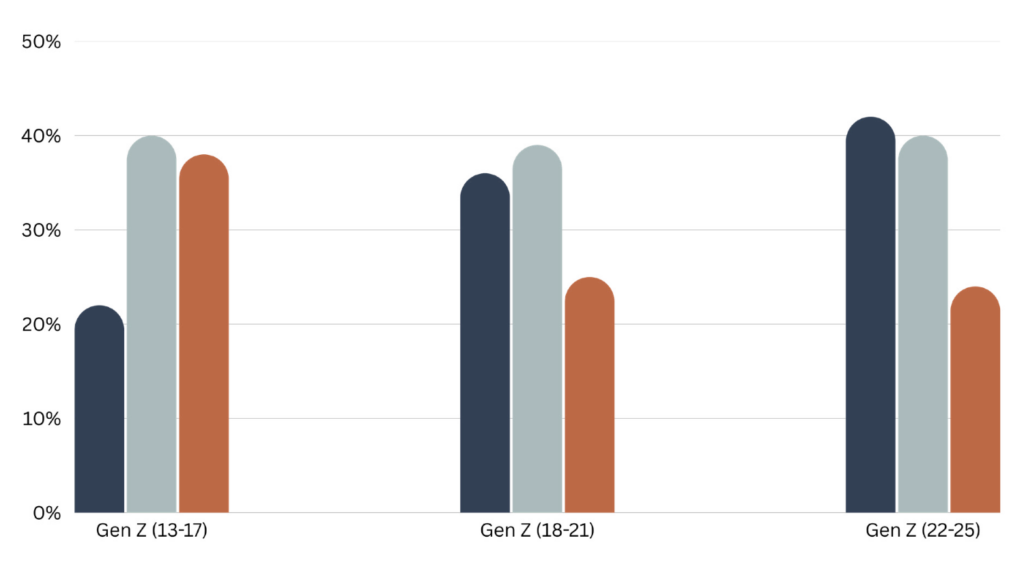
How regularly did you attend church in the past year?

Gen Z

One of the most significant findings in this study is the decline in church attendance as Gen Z ages. While discussion of Gen Z has tended to emphasize its rising rates of non-religious identification, this study finds that when measuring by attendance and even particular beliefs they are more religious as teenagers than they will be when they age out of the youth group. While nearly 38% of Gen Z teens (ages 13-17) attend church regularly, this number drops to 25% for women ages 18-21 and falls again to 24% for those 22-26. This sharp decline suggests that as Gen Z women gain independence, they drift away from structured religious engagement.

However, this does not necessarily mean they abandon faith altogether. Many still express a belief in God—87% of all respondents, and even 45% of those who self-identified as Non-Religion/Agnostic/Atheist—and the importance of spiritual principles, though they no longer see the church as a central influence in their lives. This tracks with previous studies that have found that while Gen Z is not as tied to institutional religion, it is still spiritually interested. Indifference or apathy are more emblematic of Gen Z women than the militant atheism of previous eras.

In this environment, the church’s role as educator and disciple-maker is even more important than previous generations. Planned Parenthood and others’ alternative vision for the person, sexuality, and the family are already engaging with these young women as they sit in the pew. When they leave the church, it becomes the loudest alternative voice. Thus, churches must focus on how they can disciple the Gen Z teenagers in their pews to make faith their own before they age out of youth groups and leave their congregations behind.